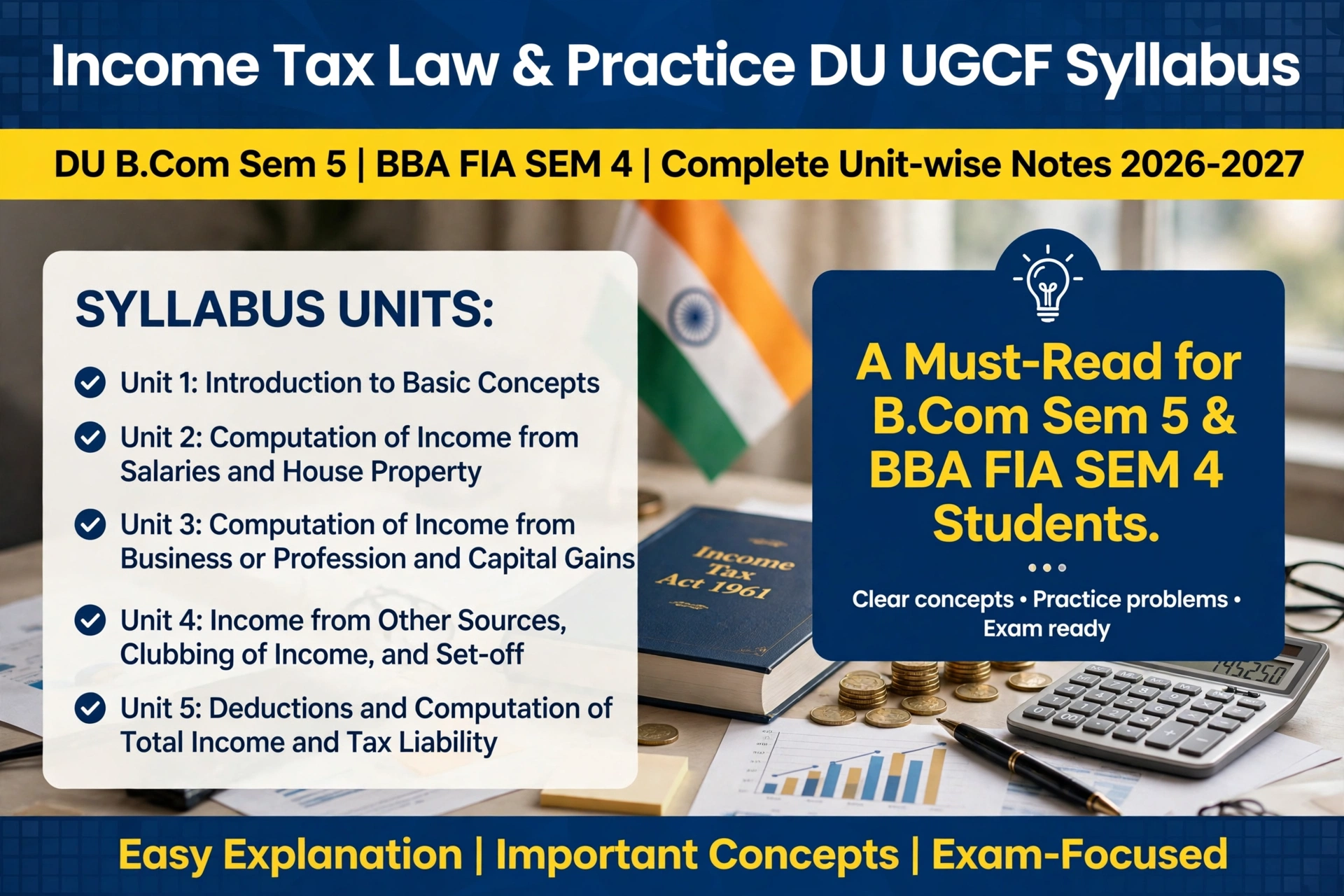
Income Tax Law and Practice—Complete Unit-wise Notes for DU B.Com & BBA FIA
Unit 1: Introduction to Basic Concepts
Income [Section 2(24)]: Inclusive definition. Includes profits & gains, salary, dividends, voluntary contributions, etc. Real income is taxable; notional income is taxable only when specifically provided.
Agricultural Income [Section 2(1A)]: Rent or revenue derived from land situated in India and used for agricultural purposes. Fully exempt under Section 10(1), but partially integrated for rate purposes if non-agricultural income exceeds the basic exemption limit.
Person [Section 2(31)]: Individual, Hindu Undivided Family (HUF), Company, Firm, Association of Persons (AOP), or Body of Individuals (BOI), Local Authority, and every Artificial Juridical Person.
Assessee [Section 2(7)]: Any person by whom any tax or any other sum of money is payable under the Act, or against whom any proceeding has been taken.
Previous Year: The financial year in which income is earned (normally 1 April to 31 March).
Assessment Year: The 12-month period immediately following the previous year.
Gross Total Income (GTI): Aggregate of income computed under all five heads before allowing deductions under Chapter VI-A.
Total Income: GTI minus deductions under Sections 80C to 80U.
Maximum Marginal Rate (MMR): The highest rate of income tax (including surcharge) applicable.
Permanent Account Number (PAN): Unique 10-digit alphanumeric number. Mandatory for filing returns and many high-value transactions.
Residential Status [Section 6]
For Individuals:
Resident if:
(a) Spends at least 182 days in India during the previous year; or
(b) Has stayed in India for a period aggregating to 60 days or more during the previous year and 365 days or more during the four years immediately preceding the previous year.
(Special rules apply for Indian citizens/Persons of Indian Origin leaving India for employment or visiting India.)
Further classified as:
Resident and Ordinarily Resident (ROR)
Resident but Not Ordinarily Resident (RNOR)
Scope of Total Income [Section 5]:
ROR → Taxed on worldwide income
RNOR → Only income received or accrued in India, along with income from a business controlled or profession established in India, is taxable
Non-Resident → Taxable only on income received, accrued, or arising in India.
Exempted Incomes under Section 10
Important exemptions: agricultural income, HRA (subject to conditions), leave travel concession, gratuity, commuted pension, provident fund, leave encashment, scholarship, etc.
Learning lessons from Kautilya’s Taxation Policy
Kautilya (in Arthashastra) advocated fair, moderate, and non-oppressive taxation. Tax should be collected like a bee collects honey—without harming the source.
Unit 2: Computation of Income from Salaries and House Property
Income from Salaries [Sections 15–17]
Basis of charge: Due basis or receipt basis, whichever is earlier.
Components of salary: Basic salary, Dearness Allowance, Bonus, commission, allowances, perquisites, and profits in lieu of salary.
Allowances:
Fully taxable (Dearness Allowance, City Compensatory Allowance, etc.)
Partly exempt (HRA, Entertainment Allowance for government employees)
Fully exempt (uniform allowance, travelling allowance on tour, etc.)
Perquisites: Valuation rules for rent-free accommodation, motor cars, free education, interest-free loans, etc.
Deductions under Section 16:
Standard Deduction: ₹75,000 (New Regime) / ₹50,000 (Old Regime)
Entertainment Allowance (only government employees)
Professional tax paid
Income from House Property [Sections 22–27]
Chargeable on the annual value of house property.
Computation:
Gross Annual Value (GAV) = Higher of Actual Rent Received/Receivable or Expected Rent
Less: Municipal taxes paid by the owner → Net Annual Value (NAV)
Less: Deductions under Section 24
Standard deduction @ 30% of NAV
Interest on borrowed capital (self-occupied: maximum ₹200,000; let-out: full amount)
Types of properties: self-occupied, let-out, deemed to be let-out, and partly self-occupied & partly let-out.
Treatment of unrealized rent and arrears of rent.
Unit 3: Computation of Income from Business or Profession and Capital Gains
Profits and Gains of Business or Profession [Sections 28–44]
Chargeable under Section 28.
Method of accounting: Cash or Mercantile (must be regularly followed).
Allowable expenses: Sections 30 to 37 (rent, repairs, insurance, salary, interest, bad debts, depreciation, etc.).
Important Disallowances: Section 40 & 40A (cash payment exceeding ₹10,000, payments to relatives without TDS, excessive payments, etc.).
Depreciation [Section 32]: Allowed on a block of assets at prescribed rates.
Presumptive Taxation:
Section 44AD (Business)
Section 44ADA (Profession)
Section 44AE (Goods Carriages)
Capital Gains [Sections 45–55]
Arises on transfer of a capital asset.
Short-term vs. long-term based on holding period (24 months for immovable property, 12 months for listed equity shares/equity-oriented mutual funds).
Computation:
Full Value of Consideration
Less: Cost of Acquisition / Indexed Cost of Acquisition
Less: Cost of Improvement / Indexed Cost of Improvement
Less: Expenditure incurred wholly and exclusively in connection with transfer
Important Exemptions: Sections 54, 54B, 54EC, 54F, etc.
Special rates apply on certain capital gains (especially equity-oriented assets).
Unit 4: Income from Other Sources, Clubbing of Income, and Set-off
Income from Other Sources [Sections 56–59]
Residual head of income.
Includes: Interest on securities, dividends, winnings from lotteries/crossword puzzles/horse races, gifts exceeding ₹50,000 from non-relatives, family pension, etc.
Deductions are allowed under Section 57 (e.g., family pension—lower of 1/3rd or ₹15,000).
Clubbing of Income [Sections 60–64]
Income transferred without adequate consideration can be clubbed.
Important provisions:
Income of spouse (in certain cases)
Income of minor child [Section 64(1A)] – clubbed with the parent having higher income (exception for disability or income from manual work/skill)
Income of son’s wife in specified cases
Aggregation of Income and Adjustment, Set-off and Carry Forward of Losses [Sections 70–80]
Inter-source adjustment (within the same head)
Inter-head adjustment (between different heads)—subject to restrictions
Carry forward losses:
House property loss → 8 years
Business loss (non-speculation) → 8 years
Speculation loss → 4 years
Capital loss → 8 years
Loss from owning & maintaining race horses → 4 years
Unit 5: Deductions and Computation of Total Income and Tax Liability
Deductions from Gross Total Income (Chapter VI-A – Sections 80C to 80U)
Section 80C (maximum ₹150,000): Life insurance premium, PPF, ELSS, NSC, tuition fees, principal repayment of housing loan, Sukanya Samriddhi, etc.
Other important deductions: 80CCD, 80D (medical insurance), 80E (education loan interest), 80G (donations), 80TTA/80TTB, 80U (disability).
Note: Most of these deductions are not available under the New Tax Regime.
Rebates and Reliefs
Section 87A rebate (New Regime): Up to ₹60,000 (makes tax nil if total income ≤ ₹12,00,000 for resident individuals).
Relief under Section 89 for arrears of salary.
Computation of Total Income and Tax Liability of Individuals
Compute income under five heads.
Apply clubbing provisions.
Set off current-year losses.
Arrive at Gross Total Income
Claim Chapter VI-A deductions.
Arrive at Total Income
Compute tax as per applicable slabs.
Add surcharge (if applicable) + 4% health & education cess.
Less: Rebate u/s 87A and relief u/s 89
Current Tax Rates (FY 2025-26 / AY 2026-27)
New Tax Regime (Default):
Up to ₹4,00,000 → Nil
₹4,00,001 – ₹8,00,000 → 5%
₹8,00,001 – ₹12,00,000 → 10%
₹12,00,001 – ₹16,00,000 → 15%
₹16,00,001 – ₹20,00,000 → 20%
₹20,00,001 – ₹24,00,000 → 25%
Above ₹24,00,000 → 30%
Old Tax Regime (optional): Basic exemption of ₹250,000 (below 60 years).
Online Filing of Returns of Income & TDS
E-filing is mandatory for most assessees.
Different ITR forms (ITR-1 to ITR-7).
Due dates, verification methods (EVC, Digital Signature, etc.), and TDS return filing procedures.
Conclusion
Income Tax Law and Practice is like the heart of the body of direct taxation in India. A clear understanding of basic concepts, residential status, the five heads of income, clubbing provisions, set-off of losses, deductions, and the method of computing total income and tax liability is essential for every student and taxpayer.
The new tax regime has simplified the structure with lower rates and fewer deductions, while the old tax regime continues to benefit those who claim substantial exemptions and deductions. Accurate computation, timely filing of returns, and proper documentation help in ensuring full compliance and avoiding penalties. Continuous updates through financial acts make it necessary to stay informed about the latest provisions. Mastery of these concepts enables correct tax planning and contributes to a transparent and efficient tax system.
FAQs
Who is regarded as a resident individual under Section 6?
An individual is treated as a resident if he/she stays in India for 182 days or more during the previous year or stays for 60 days or more in the previous year and 365 days or more in the four preceding years (subject to special rules for Indian citizens and persons of Indian origin).
Where is income from house property charged to tax?
Income from house property is charged to tax under Sections 22 to 27 on the basis of its annual value, irrespective of whether the property is self-occupied, let-out, or deemed to be let-out.
Why is residential status important for tax purposes?
Residential status determines the scope of taxable income. A resident and an ordinarily resident are taxed on global income, while a non-resident is taxed only on income that accrues or arises or is received in India.
How is tax calculated under the New Tax Regime for FY 2025-26?
Tax is calculated by applying the following slabs on total income:
Nil up to ₹400,000 → 5% → 10% → 15% → 20% → 25% → 30% above ₹24,00,000.
Thereafter, surcharge (if applicable) and 4% health & education cess are added. A rebate under Section 87A is available if total income does not exceed ₹12,00,000.
What is the maximum standard deduction available from salary income?
Under the new tax regime, the maximum standard deduction is ₹75,000. Under the Old Tax Regime, it is ₹50,000.
Why are most Chapter VI-A deductions not available under the New Tax Regime?
The new tax regime offers lower tax rates in exchange for giving up most exemptions and deductions (except a few like employer’s contribution to NPS and standard deduction). This makes the regime simpler but less beneficial for those who invest heavily in tax-saving instruments.