Unit 5: Contemporary Issues of Business Organisations
Introduction to Contemporary Issues of Business Organizations
Organizations in the modern business world must adapt to ongoing environmental changes. Global competition, technological developments, changing customer expectations, and government policies create new opportunities as well as challenges.
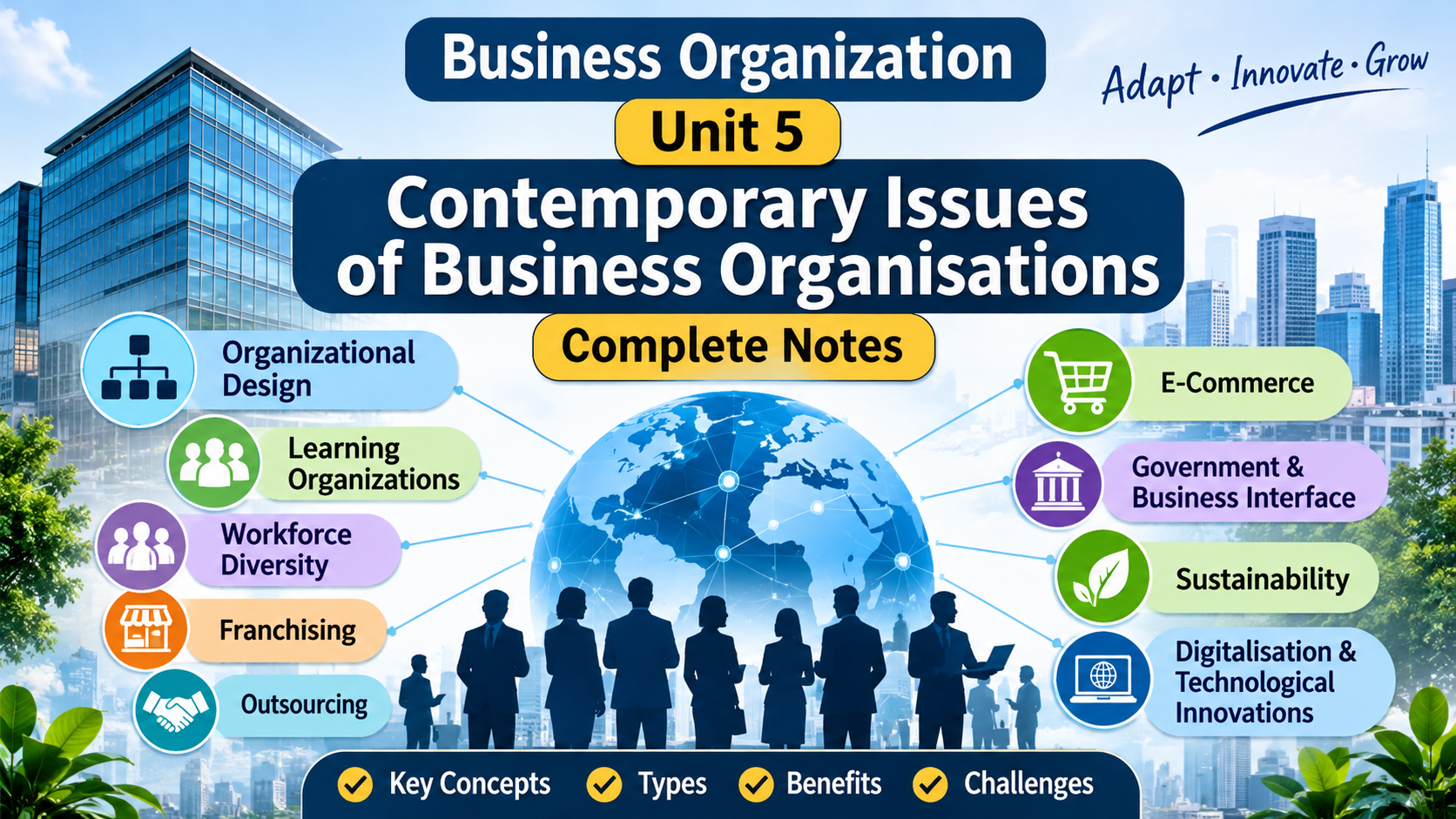
Contemporary business issues include innovation in organizational design, learning organizations, workforce diversity, franchising, outsourcing, e-commerce, government-business relationships, sustainability, digitalization, and technological innovations.
Understanding these issues helps organizations improve efficiency, adapt to changes, and achieve long-term growth.
Innovation in Organizational Design
Organizational design refers to the structure and framework through which an organization divides activities, assigns responsibilities, and coordinates its resources to achieve business objectives.
Modern organizations are adopting flexible and innovative structures to improve communication, encourage teamwork, and respond quickly to changes in the business environment.
Meaning of Organizational Structure
Organizational structure is a system that defines the roles, responsibilities, rules, and relationships within a business. It determines how activities are divided and how information flows between different levels of management.
A well-designed structure helps employees understand their duties and how their work contributes to organizational goals.
Types of Organizational Structures
Organizational structures are broadly classified into two categories:
Traditional Organizational Structure
Traditional organizational structures are based on specialization and a clear hierarchy of authority. They generally follow a pyramid-shaped arrangement consisting of top-level, middle-level, and lower-level management.
Major decisions are usually taken by top-level management and communicated to lower levels.
Types of Traditional Organizational Structures
1. Functional Structure
Activities are grouped according to business functions, such as production, marketing, finance, and human resources. Each department performs specialized activities.
2. Product Structure
Departments are organized according to the products manufactured or sold by the organization. Each product may have a separate department.
3. Geographical Structure
The organization divides its operations according to geographical regions or locations. This structure is useful for businesses operating in multiple areas.
Modern Organizational Structure
Modern organizational structures focus on flexibility, collaboration, and employee empowerment. They encourage different departments to work together without treating one function as superior to another.
Types of Modern Organizational Structures
1. Project Structure
Personnel from different sections of the organization work together to accomplish project-related goals. Teams are organized around project objectives and may continue until the project is completed.
2. Matrix Organization
A matrix organization combines functional and project structures. Staff may work under the supervision of both a functional manager and a project manager.
3. Virtual Organization
A virtual organization uses digital communication and electronic networks to coordinate business activities. It may operate with limited physical infrastructure and rely on online systems, remote teams, and external partners.
Traditional vs. Modern Organizational Structure
| Basis | Traditional Structure | Modern Structure |
|—|—|—|
| Management | Hierarchical | More flexible |
| Decision-making | Mainly centralized | Often decentralized |
| Communication | Generally follows formal channels | Encourages collaboration |
| Authority | Clearly defined levels | Greater employee empowerment |
| Work approach | Department-focused | Team and project-focused |
| Adaptability | May be slower to change | Designed to respond quickly |
Learning Organizations
Meaning of a Learning Organization
A learning organization is a business that encourages continuous learning, knowledge sharing, and employee development. It learns from past experiences, improves its performance, and adapts to changes in the business environment.
Learning organizations consider learning an ongoing process that helps employees and the organization grow.
Key Characteristics of Learning Organizations
Continuous Learning
Employees are encouraged to improve their knowledge, skills, and professional abilities through regular learning and training.
Knowledge Sharing
Employees share information, experiences, and ideas to improve teamwork and organizational performance.
Innovation
The organization encourages creativity and experimentation to develop better solutions to business problems.
Employee Empowerment
Employees are given opportunities to take initiative, participate in decisions, and contribute ideas.
Five Building Blocks of a Learning Organization
1. Systematic Problem Solving: Using logical methods and information to identify and solve problems.
2. Experimentation: Testing new ideas and approaches to improve performance.
3. Learning from Past Experience: Understanding previous successes and mistakes.
4. Learning from Others: Gaining knowledge from other organizations and individuals.
5. Transferring Knowledge: Sharing useful information throughout the organization.
Benefits of Learning Organizations
– Improves organizational performance.
– Encourages innovation and creativity.
– Increases employee engagement.
– Develops employee skills.
– Helps organizations respond to market changes.
Workforce Diversity
Meaning of Workforce Diversity
Workforce diversity refers to the presence of employees from different backgrounds, cultures, age groups, genders, abilities, and experiences within an organization.
A diverse workforce brings different perspectives, knowledge, and skills to the workplace.
Benefits of Workforce Diversity
Creativity and Innovation
Employees with different experiences and viewpoints can contribute new ideas and creative solutions.
Better Decision-Making
Different perspectives help organizations examine problems from multiple angles and make informed decisions.
Broader Market Reach
A diverse workforce can help a business understand the needs and preferences of different customer groups.
Challenges of Workforce Diversity
1. Communication Barriers: Differences in language and cultural practices may cause misunderstandings.
2. Conflict Management: Different opinions and working styles may create disagreements.
3. Bias and Discrimination: Unfair treatment may affect recruitment, promotions, and workplace relationships.
Consequences of Lack of Diversity
– Employee dissatisfaction.
– Limited perspectives.
– Reduced motivation.
– Fewer opportunities for innovation.
Diversity and Inclusion in the Workplace
Diversity means having employees from different backgrounds, while inclusion means creating a supportive and respectful environment where everyone can participate and contribute.
Ways to Develop Workplace Inclusion
1. Providing equal access to resources.
2. Encouraging group discussions.
3. Creating a learning-friendly environment.
4. Promoting collaboration.
5. Conducting awareness and sensitivity programs.
6. Supporting employee motivation and participation.
Franchising
Meaning of Franchising
Franchising is a business arrangement in which one party, known as the franchisor, allows another party, known as the franchisee, to use its brand name, trademark, products, or business model in exchange for fees or royalties.
The franchisor provides the rights and may also offer training, technology, and business support. The franchisee operates the business according to the agreed terms.
Examples of well-known franchise businesses include McDonald’s, Domino’s, Pizza Hut, Subway, and Burger King.
Parties Involved in Franchising
It refers to the owner of a brand who authorizes others to operate a business under its name.
– Franchisee: It is an individual or company that operates a business under the name and guidelines of a franchisor.
Types of Franchising
Product Franchising
The franchisee receives the right to sell products manufactured or supplied by the franchisor.
Manufacturing Franchising
The franchisee receives permission to manufacture and distribute products according to the franchisor’s requirements.
Business-Format Franchising
The franchisee uses the franchisor’s brand name, business model, and operating methods while following agreed standards.
Benefits of Franchising
– Rapid Expansion: Helps businesses expand into new locations.
– Lower Expansion Investment: Franchisees generally bear the cost of establishing their outlets.
– Brand Recognition: Franchisees benefit from an established brand and customer awareness.
Challenges of Franchising
– Maintaining consistent product and service quality.
– Dependence on the franchisor for support.
– Balancing standard business procedures with local requirements.
– Limited independence for franchisees.
Outsourcing and Business Process Outsourcing (BPO)
Meaning of Outsourcing
Outsourcing is an arrangement in which a business relies on an external service provider to perform specific operational activities. Organizations commonly outsource non-core activities so they can concentrate on their main business operations.
For example, a manufacturing company may hire an external advertising agency instead of creating its own advertising department.
Parties Involved in Outsourcing
1. Client Company: The organization that transfers a business activity to an external provider.
2. Vendor or Service Provider: The external organization responsible for performing the agreed activity.
Common Areas of Outsourcing
– Information technology services.
– Customer support.
– Advertising and marketing.
– Manufacturing activities.
– Accounting and administrative services.
Companies such as Infosys, Wipro, and HCL Technologies are examples of Indian businesses associated with technology and business process services.
Important Steps in Outsourcing
1. Selecting the appropriate activities to outsource.
2. Identifying a suitable and reliable service provider.
Benefits of Outsourcing
– Cost Reduction: May reduce operating and staffing costs.
– Access to Expertise: Provides access to specialized skills and technology.
– Scalability: Allows businesses to adjust services according to demand.
– Focus on Core Activities: Helps management concentrate on essential business functions.
Challenges of Outsourcing
– Maintaining service quality.
– Protecting confidential information.
– Managing dependence on external providers.
– Reduced direct control over outsourced activities.
E-commerce
Meaning of E-commerce
It is the process of carrying out commercial transactions, including the sale and purchase of goods and services, through online channels. It allows businesses and customers to conduct transactions using websites, mobile applications and digital platforms.
E-commerce may involve the exchange of physical products, digital information and online services.
Types of E-commerce
Business-to-Business (B2B)
Transactions take place between two businesses. For example, a manufacturer selling products to a wholesaler.
Business-to-Consumer (B2C)
A business sells products or services directly to individual customers through an online platform.
Consumer-to-Business (C2B)
An individual provides products or services to a business, such as a freelancer offering professional services to a company.
Consumer-to-Consumer (C2C)
Transactions take place between individual consumers through online marketplaces or other digital platforms.
Emerging Trends in E-commerce
1. Omnichannel Retailing: Connecting online and offline shopping channels to provide a consistent customer experience.
2. Mobile Commerce (M-commerce): Buying and selling products through smartphones and mobile applications.
3. Personalisation: Using customer information and technology to provide more relevant product recommendations and services.
Benefits of E-commerce
– Access to global markets.
– Lower transaction costs in many business models.
– Availability of services and shopping throughout the day.
– Direct communication between businesses and customers.
– Greater convenience for customers.
Challenges of E-commerce
– Cybersecurity: Protecting customer information and online payments.
– Logistics and Delivery: Managing timely and reliable product delivery.
– Customer Trust: Building confidence in product quality, sellers and online transactions.
Government and Business Interface
Meaning of Government-Business Interface
The government-business interface refers to the relationship between government authorities and business organisations. Government policies, regulations, taxation and public services influence how businesses operate.
A stable business environment, suitable infrastructure and clear policies can support economic development and business growth.
Responsibilities of Business Towards Government
1. Tax Payment: Paying applicable taxes according to the law.
2. Voluntary Programmes: Participating in relevant government-supported initiatives.
3. Government Contracts: Following the terms and conditions of government agreements.
Responsibilities of Government Towards Business
1. Infrastructure: Developing and providing fundamental facilities required for economic activities, including roads, electricity and transport.
2. Information: Making relevant business information and guidance available.
3. Transfer of Technology: Supporting access to technology and technological development.
Major Areas of Government-Business Interaction
Regulation and Compliance
Governments establish rules to encourage fair competition, protect consumers and maintain environmental standards.
Taxation Policies
Tax policies influence business costs, profits and investment decisions. Governments may also provide eligible incentives or subsidies.
Public Services
Government-provided facilities and services help businesses carry out their daily operations and achieve development.
Trade Policies
Import regulations, export rules, tariffs and trade agreements affect businesses involved in international trade.
Challenges in Government-Business Relations
– Bureaucracy: Complex procedures may delay business activities.
– Corruption: Unethical practices can affect fair competition and increase business costs.
– Changing Regulations: Frequent or unexpected policy changes may create uncertainty for businesses.
Sustainability in Business
Meaning of Business Sustainability
Business sustainability refers to operating in a way that meets present needs without compromising the ability of future generations to meet their own needs.
This approach focuses on combining economic growth with environmental sustainability and social responsibility.
Key Elements of Business Sustainability
Environmental Responsibility
Businesses should reduce pollution, waste, carbon emissions and unnecessary use of natural resources.
Social Responsibility
Organisations should follow ethical labour practices, respect human rights and contribute positively to communities.
Economic Responsibility
Businesses should maintain financial stability and profitability while considering their long-term impact on society and the environment.
Benefits of Business Sustainability
– Brand Loyalty: Responsible business practices can improve customer confidence.
– Cost Savings: Efficient use of energy and resources may reduce operating costs.
– Competitive Advantage: Sustainable practices can strengthen a company’s reputation.
– Long-Term Growth: Responsible operations support future business stability.
Challenges of Business Sustainability
– Higher initial investment in sustainable technologies.
– Complex environmental rules and compliance requirements.
– Balancing short-term financial goals with long-term sustainability.
Steps to Create a More Sustainable Business
1. Identify the Problem: Understand the environmental or social issues affecting the business.
2. Establish the Mission: Set clear sustainability objectives.
3. Develop a Strategy: Prepare practical plans to achieve the objectives.
4. Implement the Strategy: Put the planned activities into practice.
5. Assess Performance: Monitor progress and make improvements.
Digitalisation and Technological Innovations
Meaning of Digitalisation
Digitalisation refers to integrating digital technologies into business activities to improve operations, communication and decision-making.
Technological innovation involves developing new technologies or applying existing technologies in new ways to solve business problems and improve organisational performance.
Key Technological Innovations in Business
Artificial Intelligence (AI) and Machine Learning
AI and machine learning can help businesses automate tasks, analyse information, improve customer services and support decision-making.
Blockchain Technology
Blockchain is a distributed digital ledger technology that can improve transparency, record-keeping and trust in certain transactions.
Internet of Things (IoT)
The Internet of Things makes it possible for physical devices to access the internet and share collected data. Businesses use connected devices to monitor operations and improve efficiency.
5G Technology
5G provides faster and more responsive mobile connectivity, supporting applications such as connected devices, cloud services and advanced digital systems.
Cloud Computing
Cloud computing allows businesses to access computing resources, software and data storage through internet-based services.
Major Digital Initiatives in Business
1. Transition from Analogue to Digital: Converting traditional processes and records into digital formats.
2. Implementation of New Software: Using digital applications to improve business activities.
3. Data Analytics: Analysing information to support better decisions.
4. Cloud Computing: Using online computing and storage services.
5. Automation: Applying technology to perform repetitive tasks more efficiently.
Benefits of Digitalisation and Technological Innovation
– Increased Efficiency: Automation can improve productivity and reduce repetitive work.
– New Business Models: Digital platforms create opportunities for new products, services and revenue streams.
– Improved Customer Experience: Digital communication and personalised services can improve customer satisfaction.
– Better Decision-Making: Data analysis helps businesses understand performance and customer needs.
Challenges of Technological Innovation
– High Costs: New technologies may require significant initial investment.
– Skill Gaps: Employees may need regular training to use new systems.
– Data Privacy and Security: Digital systems can face cyber threats and data breaches.
– Social Disconnect: Excessive reliance on online communication may reduce face-to-face interaction.
Conclusion
Contemporary issues of business organisations highlight the importance of flexibility, innovation and responsible management in the modern business environment. Organisational design, learning, workforce diversity, franchising, outsourcing and e-commerce influence how businesses operate and grow. Government policies, sustainability and technological innovations also play important roles in shaping business activities. Understanding these concepts helps students recognise modern business challenges and learn how organisations can adapt to changing economic, social and technological conditions.
FAQs
What are contemporary issues of business organisations?
Contemporary issues are the emerging challenges and developments that influence modern businesses, including organisational design, workforce diversity, e-commerce, outsourcing, sustainability and digitalisation.
Why is organisational structure important?
Organisational structure defines roles, responsibilities, authority and communication channels. It helps coordinate activities and supports the achievement of business objectives.
Where is e-commerce used in business?
E-commerce is used through websites, online marketplaces, mobile applications and digital platforms for buying and selling products, information and services.
When should a business consider outsourcing?
A business may consider outsourcing when external providers can perform selected non-core activities efficiently, provide specialised expertise or help manage operating costs.
How can businesses achieve sustainability?
Businesses can improve sustainability by reducing waste, using resources efficiently, following ethical practices, setting environmental and social goals, and regularly evaluating their progress.