Entrepreneurship: Founding the Business—Complete Unit 4 Notes
Entrepreneurship: Founding the Business—Complete Unit 4 Notes
Entrepreneur, Entrepreneurship, and Enterprise
Meaning of an Entrepreneur
An entrepreneur is an individual who identifies a business opportunity, takes the initiative to start a new business, and accepts the associated risks and responsibilities. Entrepreneurs organize resources to create value and may introduce new products, services, ideas, or technologies.
Characteristics of an Entrepreneur
Entrepreneurs commonly have the following characteristics:
– Innovative: Introduce new ideas or improve existing products and services.
– Risk-Taker: Accept business risks for the possibility of earning profit.
– Visionary: Have a clear vision of their goals.
– Decisive: Make effective decisions to keep the business moving.
– Leadership and Motivation: Lead and motivate people toward common goals.
Types of Entrepreneurs
The major types of entrepreneurs covered in this unit are
– Builder: Creates scalable businesses, hires talent, and seeks investors.
– Opportunist: Remains involved during business growth and may exit when the business reaches its peak.
– Innovator: Develops new ideas or products.
– Specialist: Has strong skills and expertise in a specific area.
Meaning of Enterprise
An enterprise is the business or organization created through entrepreneurship. It brings together resources such as capital, labor, and technology to produce goods or services.
Forms of Enterprise
The notes identify the following forms of enterprise:
– Sole Proprietorship
– Partnership Firm
– Company
– Limited Liability Partnership
– One-Person Company
Reasons for Starting an Enterprise
An enterprise may be started:
- To solve a problem
2. To exploit an idea
3. To fill a gap
Meaning of Entrepreneurship
Entrepreneurship is the process of developing, organizing, and running a business activity. It involves innovation, risk management, resource mobilization, and value creation. Entrepreneurship also involves recognizing opportunities and taking calculated risks.
Benefits of Entrepreneurship
Major benefits include:
– Job creation
– Innovation
– Social change
– Nation building
Forms of Entrepreneurship
Small Business Entrepreneurship
Small businesses are generally started with limited resources and may have limited plans for future expansion. They may involve family members or local residents. Key features include a single product, limited scope, and risk aversion.
Scalable Startup Entrepreneurship
Scalable startups begin with limited funds but aim to expand by attracting investors. They may use experimental models and hire skilled employees. Their major features include vision, revenue generation, and capital.
Large Company Entrepreneurship
Large company entrepreneurship focuses on continuous improvement of products and services in response to competition and customer expectations. Such companies may introduce new products related to their core business.
Social Entrepreneurship
Social entrepreneurship focuses on identifying social problems and developing solutions. The notes explain that profits may be directed back into solving the identified problem.
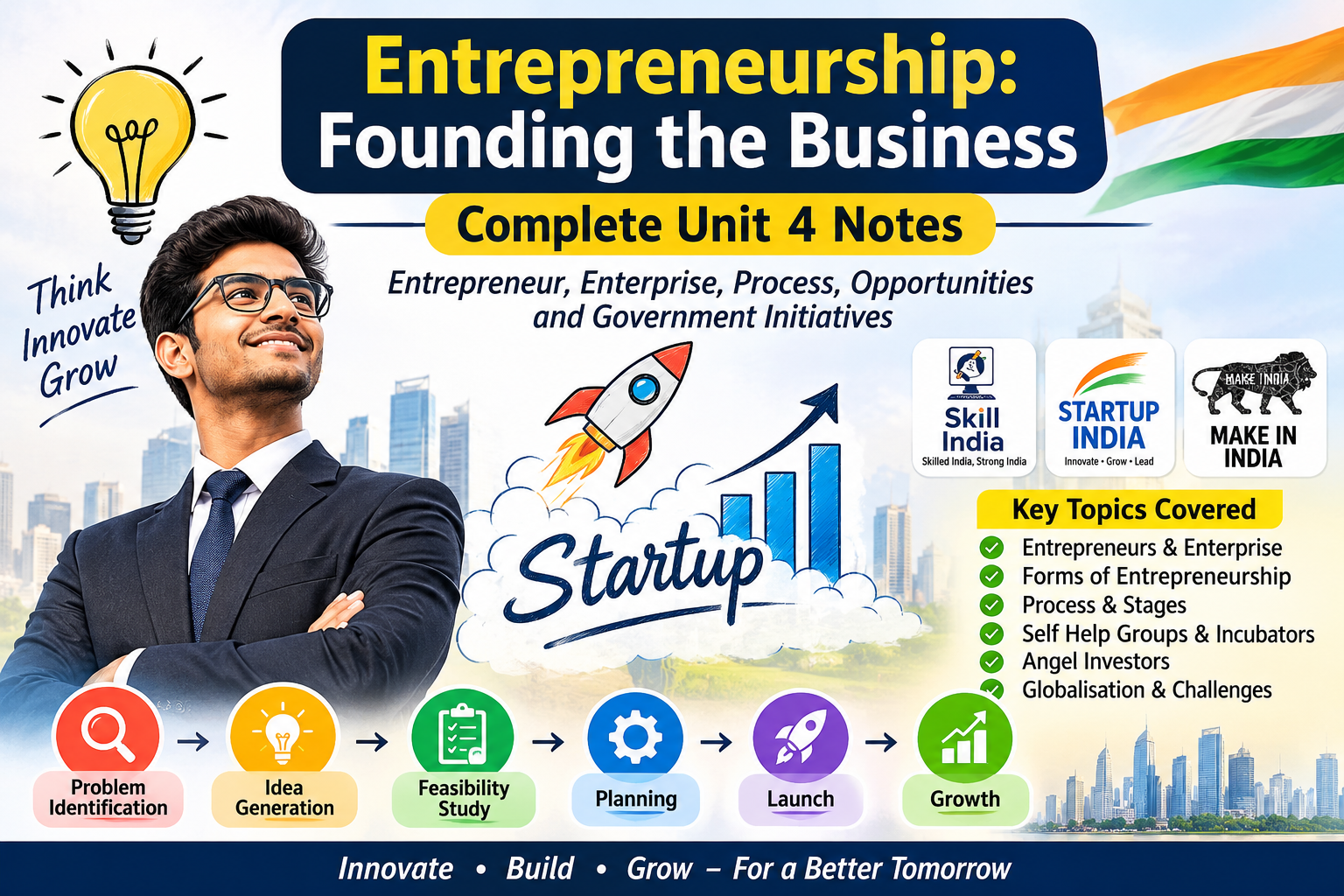
Process of Entrepreneurship
Problem Identification
The first step is identifying a need, want, problem, or deficiency in society. Entrepreneurs look for gaps in the market and identify the audience they want to serve.
Idea Generation
The business idea should consider environmental sustainability, social sensitivity, and legal requirements. Brainstorming can be conducted individually or in groups.
Feasibility Study
A feasibility study examines whether an idea is viable in terms of cost, benefits, and long-term sustainability. It may include a sample study, a field study, and a pilot study.
Planning
Planning involves arranging funds, resources, and labor and preparing for the delivery of goods or services.
Launch
After feasibility testing and resource preparation, the entrepreneur launches the idea through the enterprise.
Growth
Entrepreneurship requires continuous evaluation and improvement. Entrepreneurs seek new ideas to make the enterprise competitive and sustainable.
Entrepreneurial Ideas and Opportunities
Self-Help Groups
Self-Help Groups (SHGs) consist of people who face similar problems and work together to support one another. They encourage savings and may provide small loans to members.
Functions of SHGs
– Promoting savings
– Lending to members
– Solving problems
Business Incubators
A business incubator provides support to startups through services such as early-stage assistance, funding, workspace, networking, and mentoring.
Stages of Incubation
- Pre-incubation: Support for research activities.
2. Early-stage incubation: Support for marketing, legal, and accounting services.
3. Classic incubation: Support for networking.
4. Graduation: Investment in products and services to help startups reach end users.
Angel Investors
Angel investors are individuals with significant financial resources who invest in new businesses or ideas with the expectation of receiving a reward if the business succeeds.
Types of Angel Investors
– Corporate Angels
– Entrepreneurial Angels
– Enthusiast Angels
– Micromanagement Angels
– Professional Angels
Government Initiatives for Entrepreneurship in India
Skill India
Skill India is presented in the notes as a government initiative aimed at developing skills among youth and improving employability.
Start-Up India
Start-Up India is an initiative aimed at promoting and supporting new businesses through measures such as funding, incentives, incubation, and support.
Make it in India.
Make in India was launched to encourage manufacturing in India, attract investment, and create employment opportunities.
Globalization
Globalization creates opportunities for Indian entrepreneurs to access international markets, technology, and investment.
Make in India: Four Pillars
New Processes
The notes emphasize ease of doing business and efforts to improve the business environment.
New Infrastructure
Modern infrastructure, connectivity, logistics systems, smart cities, and industrial corridors are highlighted as important for industrial growth.
New Sectors
Make in India identified sectors covering manufacturing, infrastructure, and services, with information provided through dedicated resources.
New Mindset
The initiative seeks to change the relationship between government and industry by encouraging partnership in economic development rather than only regulation.
Start-Up India
Three Pillars of Start-Up India
The notes identify three major pillars:
- Funding support and incentives
2. Industry-academia partnership and incubation
3. Simplification and handholding
Eligibility Conditions Mentioned in the Notes
The source notes state that an entity can apply when it is incorporated as a private limited company, partnership firm, or LLP in India, has less than 10 years of history, and has turnover below INR 100 crore for the financial years since incorporation or registration.
Skill India Initiatives
Objectives of Skill India
The notes highlight:
- Adequate training
2. Creating opportunities
3. Supporting the National Skill Development Corporation
Components of Skill India
– Short-term training
– Kaushal and Rozgar Mela
– Recognition of prior learning
– Special projects
– Monitoring guidelines
Entrepreneurship and New Challenges of Globalization
Challenges of Globalization
The notes identify three major challenges:
- Mobility of Jobs: Jobs may move between developed, developing, and underdeveloped nations.
2. Dominance of Developed Nations: Developed western nations may have greater influence in international markets.
3. Threat to Cultural Diversity: Globalization can contribute to the spread of Western culture.
Advantages of Globalization
The notes identify:
- Global Advantage: Small businesses can compete in international markets.
2. Local Advantage: International businesses can enter neighboring markets.
3. Speed of Adaptability: Small businesses can respond quickly to global and local changes.
Conclusion
Entrepreneurship is an important process of identifying opportunities, developing ideas, organizing resources, and taking calculated risks to create and grow a business. This unit covers entrepreneurs, enterprises, forms, and processes of entrepreneurship, along with opportunities through self-help groups, business incubators, and angel investors. It also explains major initiatives such as Skill India, Start-Up India, and Make in India and highlights the opportunities and challenges created by globalization. Understanding these concepts helps students develop a clear foundation in entrepreneurship and its role in innovation, employment, and economic development.
Also Read: Business organization Unit 5
FAQs
What is entrepreneurship?
Entrepreneurship is the process of developing, organizing, and operating a business activity involving opportunity recognition, innovation, resources, and risk management.
Why is entrepreneurship important?
Entrepreneurship helps create jobs, encourages innovation, brings changes to society, and contributes to nation building.
Where can entrepreneurial opportunities be found?
Entrepreneurial opportunities can arise from problems, market gaps, new ideas, and changing needs in the business environment.
When does the process of entrepreneurship begin?
The process begins with identifying a problem, need, want, or deficiency and then generating a suitable business idea.
How does the entrepreneurship process work?
The process generally follows six stages: problem identification, idea generation, feasibility study, planning, launch, and growth.
What are the main challenges of globalization?
The notes identify mobility of jobs, dominance of developed nations, and threats to cultural diversity as major challenges.
What are the advantages of globalization for entrepreneurs?
Globalization can provide global market opportunities, local market opportunities, and faster adaptability for small businesses.