Unit 1: Introduction to Business Organization
Introduction to Business Organization
Business is an essential part of the economy that focuses on making, buying, selling, and distributing goods and services. A business organization is created to carry out commercial activities, typically with the dual aims of earning profit and meeting human needs.
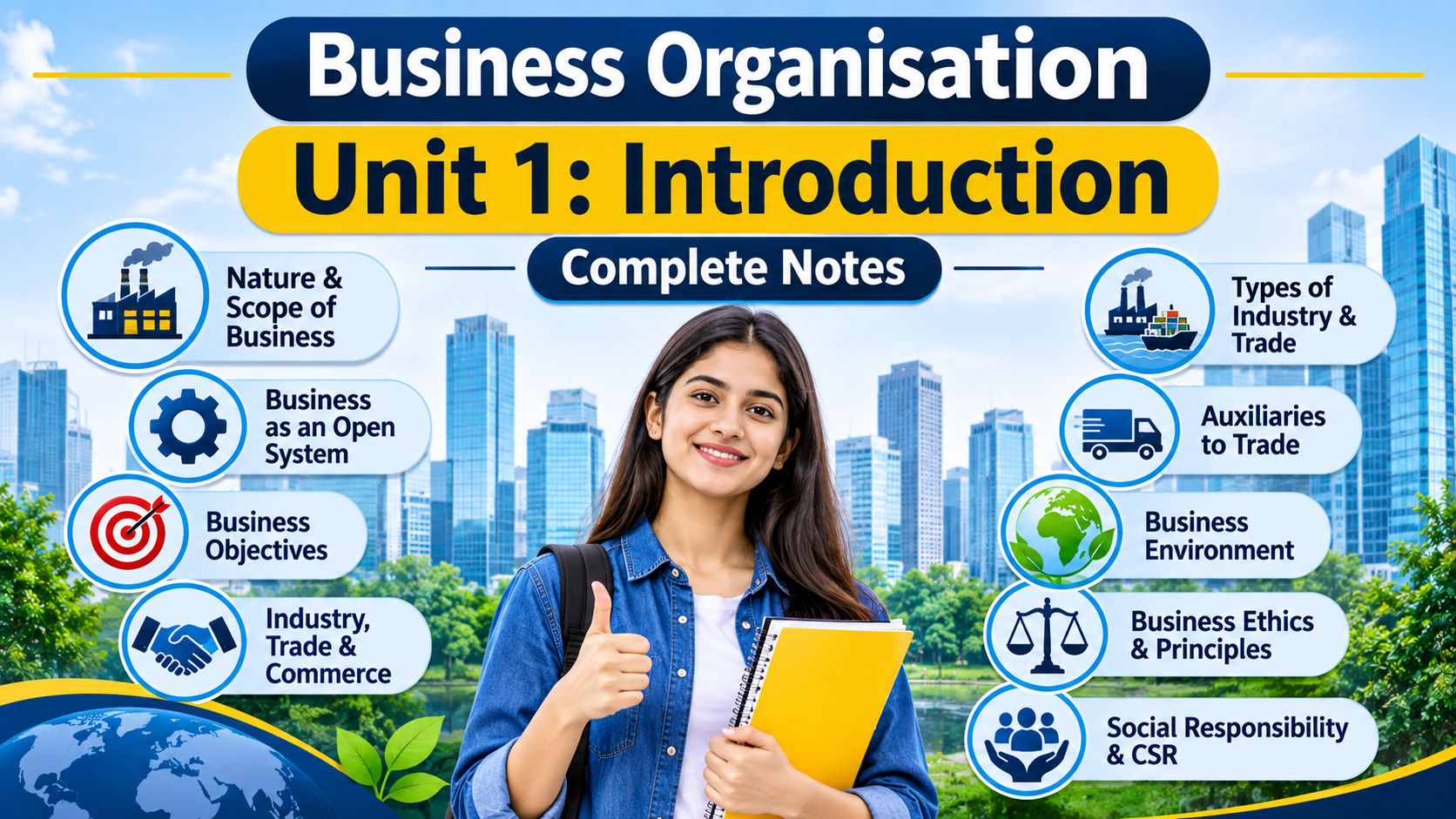
Unit 1 introduces the fundamental concepts of business, including its nature, objectives, and core components. It also explores the interrelationships among industry, trade, and commerce; the concept of business as an open system; the business environment; business ethics; social responsibility; and corporate social responsibility (CSR).
Meaning of Business
Business is an economic activity that involves the regular production and exchange of goods and services with the goal of earning profit while satisfying human wants.
In simple words, the scope of business can be understood as follows:
Business = Industry + Trade + Commerce
A business organization is an entity established to conduct commercial activities.
Economic and Non-Economic Activities
Economic activities are those performed with the primary objective of earning income or profit. Most business activities fall into this category.
Non-economic activities are undertaken for reasons other than earning income, such as personal, social, or charitable purposes.
Nature of Business
Business possesses several distinctive characteristics that set it apart from other human activities.
Dealing in Goods and Services
Business supplies goods and services to society. Goods may be intended for final consumption or for use in further production.
Recurring Transactions
Business involves regular or repeated transactions. A one-time or casual sale or purchase does not ordinarily qualify as a business activity.
Risk Element
Business carries inherent risk because many decisions concern the future, and future conditions cannot be predicted with complete certainty.
Profit Motive
Profit is a central objective of business. It enables an organization to survive, develop, and expand.
Social Obligations
Businesses also bear responsibilities toward society, including generating employment, adopting responsible practices, protecting the environment, and supplying useful goods and services.
Creation of Utility
Business activities create utility. Manufacturers transform raw materials into finished products, while wholesalers, retailers, and transporters help move those products closer to consumers.
Objectives of Business
Business objectives can be grouped into economic, human, social, national, and global categories.
Economic Objectives
Key economic objectives include:
Earning profit
Exploring new markets
Creating new customers
Increasing market share
Achieving growth and expansion
Encouraging innovation and creativity
Human Objectives
Human objectives focus on employees and owners. They include:
Providing a fair return to owners
Supporting employee learning and development
Promoting employee welfare
Improving job satisfaction
Offering fair wages
Social Objectives
Social objectives include:
Creating employment opportunities
Supplying quality goods and services
Providing fair remuneration
Protecting the environment
Avoiding anti-social business practices
National Objectives
National objectives include:
Producing in line with national priorities
Making proper use of natural resources
Paying taxes and other obligations on time
Promoting national self-sufficiency
Encouraging exports
Global Objectives
Global objectives may include promoting equality and participating in international trade through exports.
Industry, Trade, and Commerce
Business comprises three closely linked components: industry, trade, and commerce.
Industry
Industry is primarily concerned with the extraction and production of goods that may be used for final consumption or further production.
Primary Industries
Primary industries supply raw materials for further production.
Extractive industries** obtain products from natural resources (examples: farming, mining, quarrying, and hunting).
Genetic industries** focus on the breeding or reproduction of plants and animals (examples: poultry farming, cattle breeding, and fisheries).
Secondary Industries
Secondary industries change raw materials into finished goods or products that need further processing. Major forms include:
Manufacturing industry
Assembly industry
Analytical industry
Synthetical industry
Processing industry
Construction industry
Construction industries undertake projects such as roads, buildings, and bridges and contribute to infrastructure development.
Tertiary or Service Industries
Service industries provide intangible services to consumers and businesses. Examples include education, healthcare, hospitality, and marketing.
Commerce
Commerce covers activities that transfer goods and services from producers to consumers. It is mainly concerned with distribution.
Commerce helps overcome various obstacles that arise during the movement of goods from producers to consumers.
Aids or Auxiliaries to Trade
The principal auxiliaries to trade are
Transportation—Removes the hindrance of place by moving goods.
Warehousing – Warehousing allows businesses to keep products in storage until there is a demand for them.
Insurance—Offers protection against certain risks and losses.
Banking—Helps businesses meet financial needs and manage payments.
Advertising—Informs prospective buyers about goods and services.
Trade
Trade means buying products from sellers and selling them to customers to earn money.
Internal Trade
Internal (domestic) trade occurs within the boundaries of a single country. It includes:
Wholesale trade** – Buying goods in large quantities and selling them to retailers.
Retail trade** – Purchasing goods from wholesalers and selling them to final consumers.
Foreign Trade
Foreign trade takes place between different countries. It includes:
Import trade** – Purchasing goods or services from another country.
Export trade** – Selling goods or services to another country.
Entrepot trade** – Importing goods for the purpose of re-exporting them to another country.
Relationship Between Industry, Trade, and Commerce
Industry, trade, and commerce are closely interrelated.
Industry** produces goods and services.
Trade** facilitates buying and selling.
Commerce** supports the distribution of goods and services.
Without production there would be fewer goods available for trade and commerce. Likewise, without trade and commerce, industries would struggle to distribute their products to consumers. Together, the three components sustain business activity.
Business as a System
A business system is a combination of policies, personnel, equipment, and computer facilities used to coordinate the activities of a business organization. The system enables the organization to process information, coordinate operations, and achieve its objectives.
Business as an Open System
A business is an open system because it continuously interacts with its external environment.
Businesses receive inputs such as:
Raw materials
Labor
Capital
Information
Technology
These inputs are transformed through business operations into outputs—goods and services. Customers and other environmental factors provide feedback, which businesses can use to adjust and improve their operations.
Subsystems of a Business Organization
Important business subsystems include production, finance, marketing, personnel, and research and development.
Production system** – Handles production and manufacturing activities and supports production objectives.
Finance system** – Manages financial decisions, investment, expenditure, and cash flow.
Marketing system** – Deals with products, pricing, promotion, distribution, and market information.
Personnel system** – Covers human-resource activities such as manpower planning, staffing, training, motivation, and performance evaluation.
Research and development system** – Focuses on new ideas, technology, methods, and innovation that support organizational growth.
All subsystems are interconnected and require effective coordination for the organization to function successfully.
Business Environment
The business environment consists of external factors beyond an organization’s direct control that can affect its performance and decision-making. It encompasses economic, social, technological, political, and legal factors.
Economic Environment
The economic environment includes factors such as
Interest rates
Inflation
Income levels
Monetary policy
Price levels
These elements influence business costs, demand, investment, and profitability.
Social Environment
The social environment comprises customs, beliefs, education, literacy, lifestyles, values, and changing consumer preferences.
Technological Environment
The technological environment includes new technologies and production techniques. Businesses must monitor technological developments to remain competitive and improve products and services.
Political Environment
The political environment covers political conditions and government-related factors that can influence business activities.
Legal Environment
The legal environment consists of laws, regulations, administrative orders, court decisions, and other legal requirements that affect businesses.
Business and Environment Interface
A business continuously interacts with its environment through the exchange of information, resources, and influence.
Exchange of information** – Businesses gather data on customer preferences, technology, raw materials, and labor while also providing information about their products, plans, and activities.
Exchange of resources** – Businesses obtain resources from the external environment and supply goods and services to society.
Exchange of influence and power** – Government, customers, suppliers, investors, shareholders, and other groups can shape business decisions.
Strategies for Dealing with the Business Environment
Businesses can respond to environmental changes through several strategies:
Adapting and anticipating** – Preparing for expected changes and adjusting activities accordingly.
Levelling or smoothing** – Managing demand and sales across different periods to reduce the impact of fluctuations.
Rationing** – Prioritizing the use of limited resources when they are scarce.
Contracting** – Negotiating arrangements related to supplies, finance, or other needs.
Combination** – Joining forces with another organization to achieve shared objectives.
Procurement of key personnel** – Recruiting skilled and experienced employees to strengthen competitiveness and responsiveness.
Business Ethics
Business ethics refers to the principles and code of conduct that businesses are expected to follow in their operations.
Principles of Business Ethics
Important principles include:
Integrity refers to being truthful, fair, and morally responsible.
Loyalty – Demonstrating commitment to the organization and its responsibilities.
Honesty – Providing accurate and reliable information.
Respect and concern – Treating people with consideration.
Fairness – Treating people fairly and equally.
Leadership – Making responsible decisions and guiding others appropriately.
Developing Business Ethics
Organizations can strengthen ethical behavior through:
Training and awareness** – Ensuring employees and leaders understand ethical principles and know how to apply them.
Code of ethics** – Establishing a clear written code that sets expected standards of conduct.
Reporting mechanism** – Providing a secure channel for employees to report misconduct and ethical concerns.
Ethical counselling** – Offering guidance from an ethical counsellor or designated authority when difficult situations arise.
Social Responsibility of Business
Social responsibility is the obligation of an organization to act in ways that benefit society and uphold responsible values.
Internal Social Responsibility
Internal responsibilities relate to employees and include fair treatment, justice, equity, selection, training, promotion, and employee development.
External Social Responsibility
External responsibilities may involve supporting communities, generating employment, protecting the environment, and contributing to broader social development.
Arguments in Favour of Social Responsibility
Major arguments include:
Long-term self-interest of the business
Changing expectations of society
Building a positive reputation
Reducing the likelihood of excessive government intervention
Better utilization of resources
Expansion of the consumer base
Arguments Against Social Responsibility
Some arguments against social responsibility include:
Possible conflict with profit maximization
Additional costs that may ultimately be passed on to consumers
Lack of specialized social skills within businesses
Limited public support for business involvement in certain social programs
Responsibilities Towards Different Interest Groups
Businesses interact with several stakeholder groups and have distinct responsibilities toward each.
Shareholders** – Provide fair returns, protect investments, strengthen the financial position, and safeguard business assets.
Workers** – Offer fair compensation, benefits, safe working conditions, and a sense of belonging.
Consumers** – Supply quality goods and services at reasonable prices, maintain adequate supply, provide relevant information, and address grievances.
Government** – Pay taxes honestly, follow regulations, and avoid corrupt practices.
Community** – Support employment opportunities, avoid pollution, and contribute to the welfare of communities and weaker sections of society.
Suppliers** – Make fair and timely payments, maintain equitable dealings, and support suppliers in improving quality.
Corporate Social Responsibility (CSR)
Corporate Social Responsibility (CSR) refers to a company’s contribution to the well-being of society and communities through responsible social and environmental activities. CSR links business operations with ethical conduct, social development, and responsible management.
Importance of CSR
CSR can help businesses:
Build goodwill
Develop a positive public image
Support sustainable practices
Strengthen relationships with stakeholders
Build customer trust
Contribute to society
Features of CSR
CSR may involve:
Ethical and responsible business practices
Consideration of social and economic factors
Management of negative external effects
Long-term commitment to stakeholders and society
Components of Social Responsibility
Legal responsibility** – Complying with applicable laws, regulations, and government requirements.
Economic responsibility** – Operating efficiently, satisfying consumer needs, and maintaining financial viability.
Ethical responsibility** – Following ethical standards expected by society even when not mandated by law.
Voluntary or philanthropic responsibility** – Voluntarily contributing resources and activities that support society and community welfare.
Conclusion
Unit 1 of Business Organization lays the foundation for understanding business and its role in the economy. Business encompasses industry, trade, and commerce, and a business organization functions as an open system that continuously interacts with its environment.
The unit also covers business objectives, the business environment, organizational subsystems, business ethics, social responsibility, and Corporate Social Responsibility. These concepts equip students to understand how businesses operate, respond to environmental changes, and fulfill their responsibilities to various stakeholders.
A solid grasp of these topics provides a strong base for further study in business organization and related areas of management.
FAQs
1. What is a business organization?
A business organization is an establishment formed to carry out commercial activities. Its work generally involves producing, distributing, or exchanging goods and services.
2. Who are the major stakeholders of a business?
The major stakeholders include shareholders, workers, consumers, government, suppliers, and the community. A business has distinct responsibilities toward each group.
3. Why is the business environment important?
The business environment is important because external economic, social, technological, political, and legal factors can influence performance, planning, and decision-making.
4. Where do industry, trade, and commerce fit into business?
Industry is mainly concerned with production, trade with buying and selling, and commerce with activities that facilitate distribution. Together they form the core components of business.
5. When does a business operate as an open system?
A business operates as an open system because it continuously exchanges resources, information, and influence with its external environment.
6. How can a business practice social responsibility?
A business can practice social responsibility by treating employees fairly, providing quality products and services, protecting the environment, complying with laws, dealing fairly with stakeholders, and contributing positively to society.