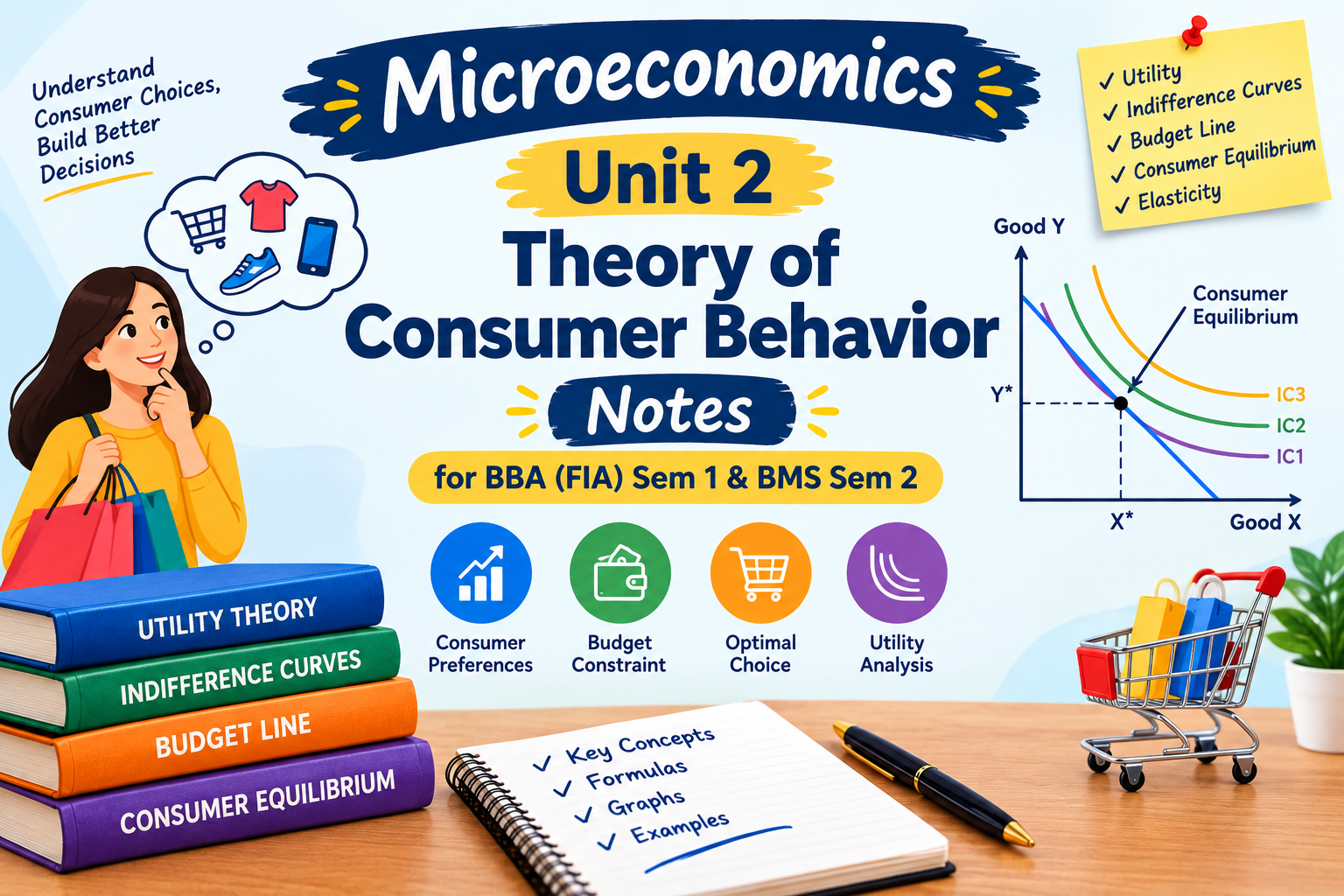
Microeconomics Unit 2: Theory of Consumer Behavior
2.1 Meaning of Consumer Behavior
Consumer behavior explains how individuals choose goods and services to maximize satisfaction while working within limited income and available market prices.
2.1.1 Concept of Utility
Utility describes the value of satisfaction that a consumer experiences through consumption. The satisfaction derived from a product varies according to personal preferences, needs, and circumstances.
2.1.1.1 Total and Marginal Utility
– Total Utility (TU): Overall satisfaction from consuming a given quantity.
– Marginal Utility (MU): Additional satisfaction gained from consuming one more unit.
$$
MU=\frac{\ Delta TU}{\ Delta Q}
$$
2.2 Cardinal Utility Theory
Cardinal utility theory assumes that satisfaction can be represented numerically in hypothetical units called utils. It uses this assumption to explain how consumers make purchasing decisions.
2.2.1 Law of Diminishing Marginal Utility
The law states that additional satisfaction generally decreases as a consumer consumes successive units of the same product, provided other conditions remain unchanged.
2.2.1.1 Example of Diminishing Marginal Utility
Suppose the first slice of pizza provides 10 hypothetical utils, the second provides 8, and the third provides 6. Total utility continues to increase, but each additional slice contributes less satisfaction than the previous one.
When marginal utility reaches zero, total utility reaches its maximum in the simplified model. If marginal utility becomes negative, additional consumption reduces total utility.
2.2.2 Law of Equi-Marginal Utility
This law explains how consumers allocate their budgets across several products to obtain maximum total satisfaction.
2.2.2.1 Equilibrium Condition
For two goods, X and Y:
$$
\frac{MU_X}{P_X}=\frac{MU_Y}{P_Y}
$$
At an interior optimum, marginal utility per rupee is equal across goods. If one product provides more marginal utility per rupee, shifting expenditure towards that product may improve satisfaction.
2.3 Ordinal Utility Theory
Ordinal utility theory assumes that consumers can rank alternative combinations of goods according to preference without measuring satisfaction numerically.
2.3.1 Indifference Curves
An indifference curve shows different bundles of two goods that provide the same satisfaction to an individual.
2.3.1.1 Properties of Indifference Curves
Indifference curves typically have a downward-sloping shape when consumers value both goods.
– They are usually convex to the origin under diminishing marginal rate of substitution.
– Higher curves represent more preferred combinations under standard assumptions.
– They do not intersect when consumer preferences are consistent and transitive.
2.3.2 Marginal Rate of Substitution (MRS)
The marginal rate of substitution indicates how consumers substitute one commodity for another while maintaining the same level of satisfaction.
2.3.2.1 Diminishing MRS
Diminishing MRS occurs when consumers become less willing to sacrifice one good for additional quantities of another.
2.4 Budget Line
A budget line represents the various quantities of two goods that a consumer can buy without exceeding their income.
2.4.1 Budget Equation
$$
P_X X+P_Y Y=I
$$
Here, $P_X$ and $P_Y$ represent prices, $X$ and $Y$ represent quantities, and $I$ represents income.
2.4.1.1 Changes in the Budget Line
An income change shifts the budget line parallel to itself if prices remain constant. A change in one product’s price alters its slope and rotates the line.
2.5 Consumer Equilibrium and Choice
Consumer equilibrium occurs when the consumer selects the most preferred affordable combination of goods.
2.5.1 Equilibrium Condition
For an interior optimum:
$$
MRS_{XY}=\frac{P_X}{P_Y}
$$
The condition indicates that the consumer’s willingness to exchange goods matches the market’s relative prices.
2.5.1.1 Tangency and Corner Solutions
In the standard graphical model, equilibrium often occurs where the highest attainable indifference curve touches the budget line. However, some preferences produce a corner solution, in which the consumer spends the entire budget on one good.
2.6 Price Effect, Substitution Effect, and Income Effect
The price effect describes the overall change in quantity demanded following a change in a product’s price. It consists of substitution and income effects.
2.6.1 Substitution Effect
The substitution effect occurs because a price change alters the relative attractiveness of different goods. When a product becomes cheaper relative to alternatives, consumers generally substitute towards it.
2.6.1.1 Example
If coffee becomes cheaper while tea prices remain unchanged, consumers may purchase more coffee and reduce their consumption of tea.
2.6.2 Income Effect
The income effect arises because a price change alters the consumer’s purchasing power, even if money income remains unchanged.
2.6.2.1 Normal and Inferior Goods
For a normal good, a price reduction generally increases quantity demanded through both substitution and income effects.
For an inferior good, the substitution effect encourages greater consumption after a price reduction, but the income effect may work in the opposite direction.
2.6.3 Giffen Goods
A Giffen good is an unusual inferior good for which the negative income effect outweighs the substitution effect.
2.6.3.1 Why Giffen Goods Are Exceptional
Under specific conditions, an increase in price may cause consumers to purchase more of a Giffen good because their reduced purchasing power forces them to rely more heavily on that essential product. Such behavior is rare and requires particular income and substitution conditions.
Exam Preparation Strategy
For each unit, focus on definitions, assumptions, formulas, diagrams, equilibrium conditions, and practical examples. Practise drawing demand and supply curves, indifference curves and budget lines, production curves, isoquant-isocost diagrams, and the cost and revenue curves associated with different market structures. These are useful foundations for answering both conceptual and numerical questions in microeconomics.
Also Read: Unit 1: Demand, Supply, and Market Equilibrium
Unit 3: Producer Behavior and Optimal Production Choice
FAQs: Unit 2 – Theory of Consumer Behavior
1. What is consumer behavior in microeconomics?
Consumer behavior explains how individuals choose goods and services to maximize satisfaction within their available income.
2. What is the difference between total utility and marginal utility?
Total utility is the overall satisfaction gained from consumption, while marginal utility is the additional satisfaction obtained from consuming one more unit.
3. What is the law of diminishing marginal utility?
It states that the additional satisfaction from consuming successive units of a product generally decreases, assuming other factors remain constant.
4. What is the difference between cardinal and ordinal utility?
Cardinal utility assumes satisfaction can be measured numerically, while ordinal utility ranks consumer preferences without measuring satisfaction numerically.
5. What is consumer equilibrium?
Consumer equilibrium occurs when a consumer chooses the most preferred affordable combination of goods. For an interior optimum, the condition is:
$$
MRS_{XY}=\frac{P_X}{P_Y}
$$