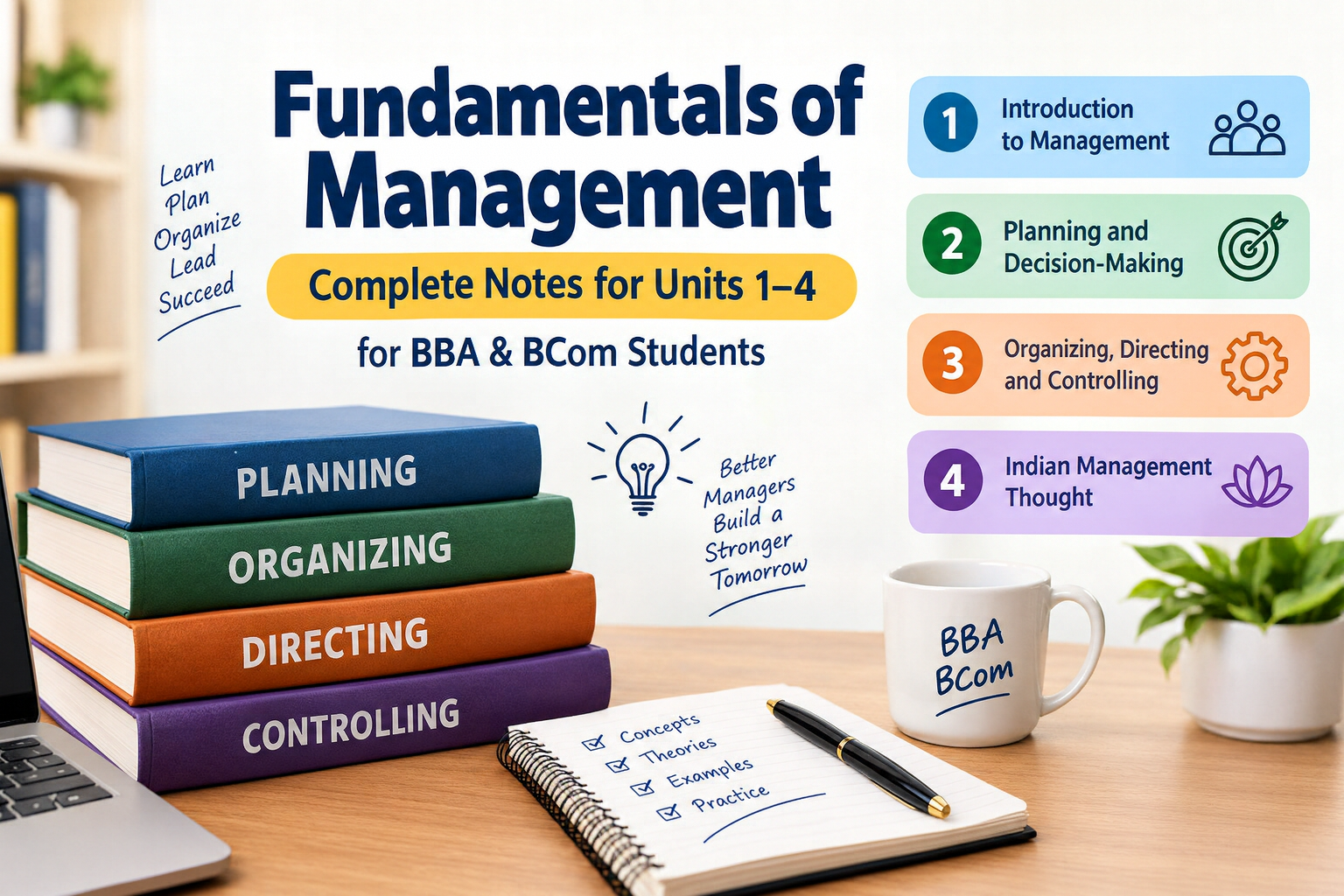
Fundamentals of Management: Complete Notes for Units 1–4
Introduction to Fundamentals of Management
Fundamentals of Management introduces the principles and practices used to manage people, resources, and organizational activities. It explains how organizations set objectives, plan their work, distribute responsibilities, guide employees, and evaluate performance.
These concepts are useful for students of Bachelor of Business Administration (BBA), Bachelor of Commerce (BCom), and other management-related courses.
These notes cover four broad units: introduction to management, planning and decision-making, organizing and managerial functions, and Indian management thought. Topic coverage may vary according to the university syllabus.
Unit 1: Introduction to Management
1.1 Definition of Management
Management is the practice of planning, arranging, guiding, and controlling resources and operations to ensure the successful achievement of organizational goals.
– Efficiency: Using resources carefully and reducing unnecessary waste.
– Effectiveness: Achieving the intended objectives.
For example, a college canteen manager must provide meals on time, maintain food quality, manage staff, and control costs. These activities require effective management.
Some well-known management thinkers include:
– Harold Koontz: Emphasized getting things done through and with people in organized groups.
– Peter Drucker: Focused on management, organizational performance, people, and results.
– Mary Parker Follett: Described management as the art of getting things done through people.
These perspectives highlight the importance of coordination, people, and organizational goals.
1.2 Nature and Characteristics of Management
The main characteristics of management are
– Goal-oriented: Management activities support specific objectives.
– Universal: Management is relevant to businesses, hospitals, educational institutions, and nonprofit organizations, although practices differ.
– Continuous: Planning, organizing, directing, and controlling take place throughout an organization’s operations.
– Dynamic: Management adapts to changes in technology, competition, and customer expectations.
– Integrative: It coordinates people, money, materials, information, and technology.
– Group activity: It brings individual and team efforts together to achieve shared goals.
1.3 Functions of Management
Planning: Identifying future objectives and preparing a course of action along with the resources needed to achieve them.
Organizing: Dividing work, assigning responsibilities, and arranging resources.
Directing: Guiding, supervising, communicating with, and motivating employees.
Controlling: Measuring performance, comparing it with standards, identifying deviations, and taking corrective action.
These functions are interconnected. For example, a manager may revise a plan after performance reports show that the original target is unrealistic.
1.4 Importance of Management
Management helps organizations:
– Achieve objectives through coordinated activities.
– Use available resources efficiently.
– Improve cooperation between employees and departments.
– Respond to changes in markets and technology.
– Support employee development through training and feedback.
– Evaluate new ideas and introduce improvements.
Effective management cannot guarantee success, but it supports informed decisions and systematic problem-solving.
1.5 Managerial Roles and Skills
Henry Mintzberg grouped managerial roles into three categories:
– Interpersonal roles: Representing the organization, leading employees, and maintaining professional relationships.
– Informational roles: Collecting, interpreting, and communicating information.
Decisional roles: Determining the best course of action, assigning resources, and handling organizational difficulties.
Managers also need three important skills:
1. Technical skills: Knowledge and understanding of the practical methods and technical processes involved in a particular job.
2. Human skills: The ability to communicate, cooperate, motivate, and work with others.
3. Conceptual skills: The ability to understand the organization as a whole and recognize relationships between its activities.
Technical skills are especially useful in operational roles, while conceptual skills often become more important in senior management. Human skills are valuable at every level.
1.6 Evolution of Management Thought
Management theories developed as organizations grew and their activities became more complex.
Classical approaches
– Scientific management — F. W. Taylor: Focused on systematically studying work methods to improve productivity.
– Administrative management—Henri Fayol: Emphasized managerial functions and principles of administration.
– Bureaucratic management—Max Weber: Emphasized formal rules, hierarchy, defined responsibilities, and merit-based administration.
Behavioral approach: Studies employee behavior, motivation, leadership, and group relationships.
Quantitative approach: Uses mathematics, statistics, forecasting, and operations research to support decisions.
Modern approaches
– Systems approach: Views an organization as interconnected parts interacting with one another and their environment.
– Contingency approach: Suggests that the appropriate management method depends on the situation.
– Total Quality Management (TQM): Focuses on continuous improvement and customer-oriented quality.
– Lean management: Aims to reduce unnecessary activities and improve work processes.
1.7 Management as a Science, Art, and Profession
Management as a science: It uses organized knowledge, principles, research, and analysis. However, it is not an exact science because people and situations vary.
Management as an art: Managers apply knowledge, judgement, creativity, and experience to solve practical problems.
Management as a profession: Management requires specialized knowledge and ethical conduct. However, it does not have all the characteristics of a fully regulated profession in every country or context.
Unit 2: Planning and Decision-Making
2.1 Meaning and Importance of Planning
Planning: Planning means preparing in advance by setting objectives and deciding the steps, resources, and time required to accomplish them successfully.
Planning is future-oriented, continuous, goal-focused, and concerned with selecting among alternatives.
Its benefits include:
– Providing direction to employees.
– Anticipating risks and preparing responses.
– Improving coordination.
– Supporting informed decisions.
– Establishing standards for evaluating performance.
Planning reduces uncertainty but cannot eliminate it. Unexpected events may require adjustments.
2.2 Types of Plans
– Strategic plans: Broad, long-term plans that guide the organization’s direction.
– Tactical plans: Plans that translate strategic objectives into departmental actions.
– Operational plans: Detailed plans for routine activities and short-term targets.
– Contingency plans: Alternative arrangements for unexpected situations.
– Single-use plans: Plans for a specific, non-recurring purpose, such as organizing a conference.
– Standing plans: Policies, procedures, and rules used repeatedly.
2.3 Steps in the Planning Process
A typical planning process includes:
1. Set objectives: Define the results to be achieved.
2. Analyze the situation: Examine resources, opportunities, and constraints.
3. Develop alternatives: Identify possible courses of action.
4. Evaluate alternatives: Compare costs, benefits, risks, and feasibility.
5. Select a plan: Choose a suitable option.
6. Implement the plan: Assign responsibilities and allocate resources.
7. Monitor results: Measure progress and make adjustments when necessary.
For example, a student society planning an event may estimate attendance, prepare a budget, compare venues, assign tasks, and review expenses afterward.
2.4 Management by Objectives (MBO)
Management by Objectives is an approach in which managers and employees agree on specific objectives and assess performance against them.
The process generally involves:
1. Establishing organizational objectives.
2. Agreeing on individual or team objectives.
3. Developing action plans.
4. Monitoring progress.
5. Evaluating results and providing feedback.
Example: A sales manager and employee agree on a quarterly target, identify the required activities, and review progress during the quarter.
MBO can improve clarity and accountability. However, poorly designed targets may encourage employees to focus on numbers at the expense of quality.
2.5 Management by Exception (MBE)
Management by Exception directs managerial attention towards significant deviations from established standards.
For example, if expenses remain within an approved budget, a manager may review routine reports. A substantial overspend may require investigation.
Management by Exception (MBE) reduces the time required for supervision, but managers must define clear standards and remain aware of issues that figures may overlook.
2.6 Decision-Making in Management
Decision-making: Decision-making refers to identifying and choosing the best alternative to solve a problem or achieve a goal.
Common types include:
– Strategic decisions: Affect the organization’s long-term direction.
– Tactical decisions: Help implement strategies within departments.
– Operational decisions: Concern daily activities.
– Programmed decisions: Repeated decisions handled through established rules or procedures.
– Non-programmed decisions: New or unusual decisions requiring judgment and analysis.
A systematic decision-making process involves identifying the problem, gathering information, developing alternatives, evaluating options, selecting an action, implementing it, and reviewing the outcome.
Good decisions consider evidence, costs, risks, resources, and likely consequences.
Unit 3: Organizing, Directing, and Controlling
3.1 Principles of Organizing
Organizing establishes how tasks, authority, and responsibilities are distributed.
Important principles include:
– Division of work: Breaking activities into manageable tasks to support specialization.
– Unity of command: Employees should generally know who has direct authority over their work.
– Unity of direction: Activities with the same objective should follow an appropriately coordinated plan.
– Scalar chain: The formal chain of authority should be clear.
– Coordination: Employees and departments should cooperate towards common objectives.
These principles are useful guidelines, but organizations may adapt them to operational needs.
3.2 Organizational Structure and Authority
Organizational structure defines reporting relationships, responsibilities, and the distribution of authority.
Three common forms of authority are:
Line authority: Direct authority over subordinates within the formal reporting structure.
Staff authority: Advisory or specialist support provided to managers, such as legal or human resources advice.
Functional authority: Limited authority over a particular function or activity, sometimes extending across departments.
Clear authority and responsibility help employees understand who makes decisions and who is accountable for results.
3.3 Departmentation
Departmentation means grouping related activities into departments or units.
Common methods include:
– Functional: Grouping activities such as finance, marketing, and human resources.
– Product: Organizing work around different products or product lines.
– Geographical: Grouping operations by region or location.
– Customer: Organizing activities around customer groups.
– Process: Grouping activities according to stages of a production or service process.
The suitable method depends on organizational size, objectives, products, and operating environment.
3.4 Span of Control
Span of Control: It represents the number of subordinates directly managed by a single supervisor.
– Narrow span: The manager supervises relatively few employees.
– Wide span: The manager supervises more employees.
The appropriate span depends on task complexity, employee experience, geographical distance, communication systems, and the supervision required. A wider span is not automatically better.
3.5 Centralization and Decentralization
Centralization concentrates important decision-making authority at higher management levels.
Decentralization distributes some decision-making authority to lower levels or different parts of an organization.
Centralization may improve consistency and control. Decentralization can support faster local decisions and greater employee responsibility. Many organizations combine both approaches depending on the type of decision and its risks.
3.6 Directing Function of Management
Directing guides and motivates employees so that planned activities are carried out effectively.
Its main elements are:
– Supervision: Monitoring work and providing guidance.
– Leadership: Influencing people towards shared objectives.
– Motivation: Encouraging employees through recognition, responsibility, suitable incentives, and meaningful work.
– Communication: Sharing instructions, information, feedback, and expectations clearly.
For example, a team leader can improve project coordination by explaining responsibilities, encouraging questions, resolving disagreements, and recognizing progress.
3.7 Controlling Function of Management
Controlling helps managers determine whether actual performance meets established standards.
The control process generally involves:
1. Setting performance standards.
2. Measuring actual performance.
3. Comparing results with standards.
4. Identifying and analysing deviations.
5. Taking corrective action where necessary.
6. Reviewing the results of that action.
Example: If a business sets a monthly delivery target, managers can compare completed deliveries with the target, identify delays, and adjust staffing or scheduling.
3.8 Techniques of Managerial Control
– Budgetary control: Compares actual income and expenditure with budgeted amounts.
– Quality control: Checks whether products or services meet specified standards.
– Performance reports: Summarize results against targets.
– Audits: Examine records, processes, or controls for accuracy and compliance.
– Inventory control: Monitors stock to reduce shortages, excess inventory, and related costs.
Effective control should support improvement rather than focus only on finding mistakes.
Unit 4: Contemporary Perspectives of Indian Management Thought
4.1 Gurukul Concepts in Modern Organizations
The traditional Gurukul system is associated with teacher–student interaction, guidance, discipline, and learning through observation and practice.
Some principles have parallels in modern workplaces:
– Mentoring: An experienced person guides a less experienced colleague.
– Coaching: A manager helps an employee develop a particular skill.
– Learning by observation: Employees learn by observing experienced professionals.
– Values and discipline: Organizations communicate expected standards of conduct and responsibility.
These are comparisons rather than claims that traditional educational institutions and modern workplaces operate in the same way.
4.2 Indian Wisdom and Management Values
Indian philosophical traditions contain ideas that can inform discussions of leadership and organizational conduct.
– Dharma: Often associated with duty, ethical responsibility, and appropriate conduct.
– Satya: Associated with truthfulness and honesty.
– Ahimsa: Associated with non-violence and avoiding harm.
In organizational settings, these ideas may encourage ethical decisions, honest communication, respect for people, and responsible conduct. Their interpretation varies across philosophical traditions, so they should not be treated as one universal management formula.
4.3 Features of the Indian Business Environment
Indian businesses operate in a diverse economic, cultural, and institutional environment.
Cultural and linguistic diversity: Organizations may need to adapt communication and workplace practices to different regions and communities.
Large and varied markets: Businesses serve customers with different needs, income levels, and purchasing habits.
Informal economic activity: Understanding activities outside some formal business structures is important when studying employment, distribution, and entrepreneurship.
Public–Private Partnerships (PPPs): Public bodies and private organizations may cooperate to deliver infrastructure or services under defined arrangements.
Community-based business networks: Communities such as Chettiars and Marwaris have historical associations with trade, finance, and entrepreneurship. Their practices should be studied in context rather than generalized to every individual.
Family-owned enterprises: Family businesses often combine long-term ownership, family involvement, and professional management.
These characteristics create opportunities and challenges for managers.
4.4 Examples of Indian Management Practices
Mumbai Dabbawalas: Their lunch-delivery system is often discussed in relation to coordination, standardized processes, time management, and reliability.
Amul: The dairy cooperative model provides an example for studying cooperation among producers, supply-chain coordination, branding, and distribution.
Swachh Bharat Mission: This public initiative can be studied through planning, public communication, stakeholder participation, implementation, and performance monitoring.
Atmanirbhar Bharat and Production Linked Incentive (PLI) schemes: These initiatives provide examples for examining industrial policy, investment incentives, domestic production, and the relationship between government policy and business decisions.
Indians working internationally: Professionals in information technology, medicine, higher education, and the merchant navy provide contexts for studying professional skills, teamwork, international careers, and cross-cultural management.
These examples illustrate different organizational settings. Their outcomes should be assessed using reliable evidence rather than assumptions that any one practice guarantees success.
Conclusion
Fundamentals of Management provides a foundation for understanding how organizations set objectives, arrange resources, guide employees, and evaluate results. Unit 1 introduces management concepts and theories; Unit 2 examines planning and decision-making; Unit 3 focuses on organizing, directing, and controlling; and Unit 4 explores Indian management thought and the Indian business environment.
For BBA and BCom students, these topics provide a starting point for connecting management theory with practical organizational situations. Compare these notes with your prescribed syllabus, textbook, and university examination requirements before using them for exam preparation.
Frequently Asked Questions (FAQs)
1. What are the fundamentals of management?
Fundamentals of Management covers the basic concepts, principles, and functions used to manage organizations, including planning, organizing, directing, and controlling.
2. Who are the main contributors to classical management theory?
F. W. Taylor is associated with scientific management, Henri Fayol with administrative management, and Max Weber with bureaucratic management.
3. Why is management important?
Management helps organizations set objectives, coordinate people and resources, monitor performance, respond to change, and make informed decisions.
4. What are the four main functions of management?
The four commonly taught functions are planning, organizing, directing or leading, and controlling. Some textbooks discuss staffing separately.
5. What is Management by Objectives (MBO)?
MBO is an approach in which managers and employees jointly establish objectives and assess performance against agreed targets.
6. What is the difference between centralization and decentralization?
Centralization keeps more decision-making authority at higher management levels. Decentralization distributes some authority to lower levels, allowing decisions to be made closer to the relevant activities.